
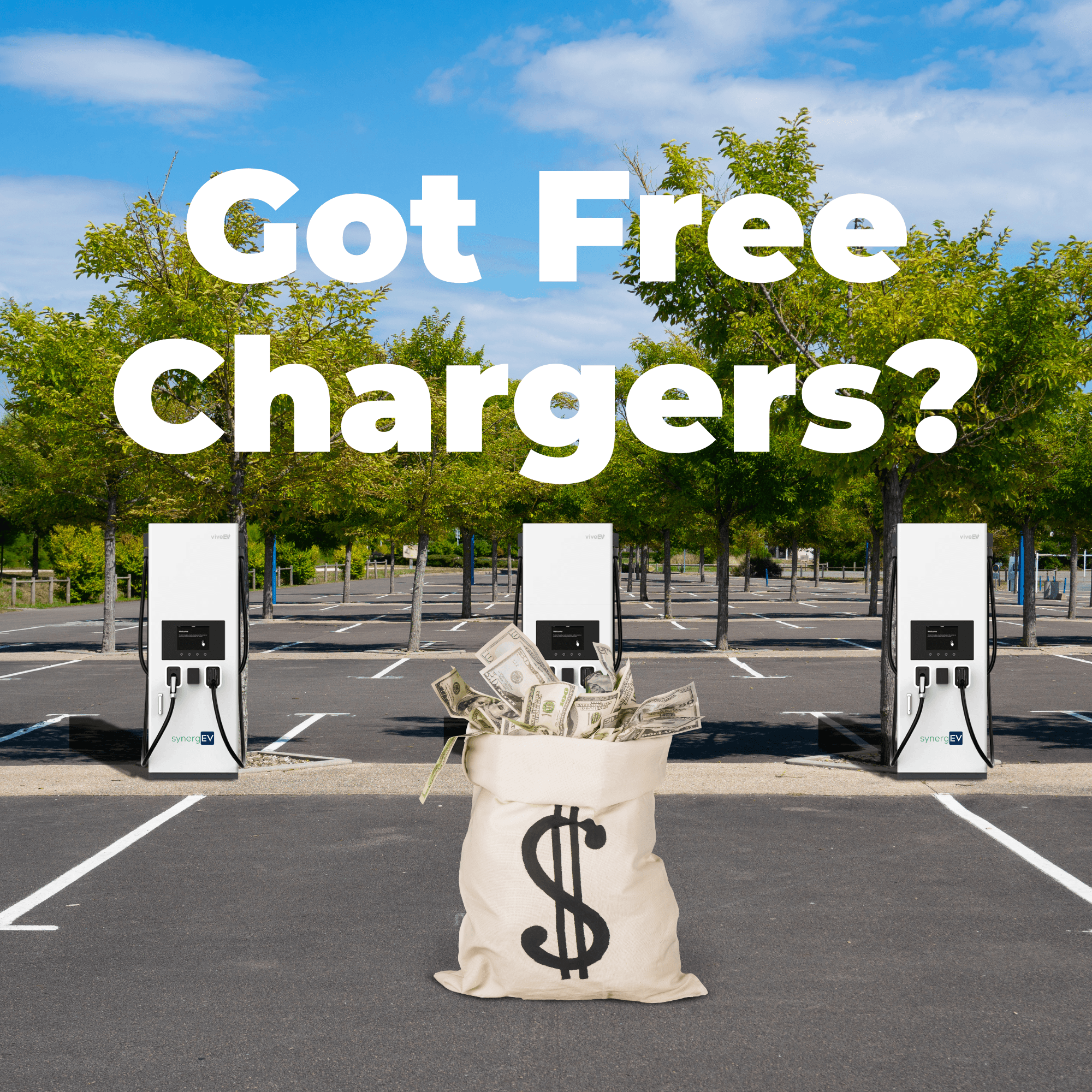
EV chargers at your business - fully funded. Thanks to a powerful combination of federal tax credits, state grants, and utility rebates, business owners and property managers across the US can install EV charging infrastructure at little to no out-of-pocket cost. The programs are out there, but finding them and navigating the paperwork is a full-time job on its own. synergEV does it all for you we locate every incentive your property qualifies for and handle every form, so you can focus on what you do best.
As electric vehicle (EV) adoption accelerates across the United States, business owners and property managers face a growing demand for charging infrastructure. Installing EV chargers is a strategic move that attracts high-value customers, retains tenants, and future-proofs properties. The initial capital required for hardware and installation often deters businesses from making this essential upgrade. However, a combination of federal tax credits, state grants, and utility rebates can offset these expenses entirely, allowing properties to add EV chargers at virtually no cost. However, this can sound like an overwhelming process for business owners.
The landscape of EV charging incentives is robust but complex. Navigating the various programs requires time and expertise that many business owners simply do not have. This is where synergEV steps in. We specialize in identifying every available incentive and handling the entire paperwork process from start to finish, ensuring that your business maximizes its savings without the administrative headache. Let's go over some of the available incentives we can explore for your project.
The Federal Foundation: The 30C Tax Credit
The cornerstone of commercial EV charging incentives is the Alternative Fuel Vehicle Refueling Property Credit, commonly known as the 30C tax credit [1]. Revitalized by recent federal legislation, this program provides substantial financial support for businesses installing charging stations in eligible locations.
The 30C credit covers up to 30% of the total project cost, including both equipment and labor, capped at $100,000 per single item of property, which typically translates to each individual charging port [1]. To qualify for the full 30% rate, projects must meet specific prevailing wage and apprenticeship requirements during construction. If these requirements are not met, the baseline credit is 6% [1].
Eligibility for the 30C credit is geographically targeted. The charging property must be placed in service within a low-income community census tract or a non-urban census tract [1].
While this may sound restrictive, approximately two-thirds of the United States population resides in eligible areas. This federal incentive is currently scheduled to expire for property placed in service after June 30, 2026, making it imperative for businesses to act swiftly [1].
Need more time to consider whether EV charging is right for your business? There are multiple other programs that we can explore so that you can benefit from incentives after the 30C credit expires.
Stacking State and Utility Rebates
While the federal tax credit provides a strong foundation, the key to achieving a "no-cost" installation lies in stacking state-level grants and local utility rebates. Across the country, state governments and utility providers are heavily subsidizing the deployment of commercial EV infrastructure to meet clean energy goals and manage grid demand [2].
State programs vary widely but often offer substantial direct funding. For example, the California Electric Vehicle Infrastructure Project (CALeVIP) provides rebates that can reach up to $7,500 for Level 2 chargers and $20,000 for Direct Current Fast Chargers (DCFC) at commercial and multi-unit dwelling sites [2]. Similarly, New York's Charge Ready NY program offers up to $4,000 per Level 2 charging port [2].
Utility companies are equally aggressive in their support. Many utilities offer "make-ready" programs that cover the cost of upgrading electrical panels, running conduit, and preparing the site for charger installation, which is often the most expensive part of the project. Utilities such as Eversource, Duke Energy, and Pacific Gas and Electric (PG&E) provide commercial rebates that can range from $2,500 to over $25,000 per site, depending on the hardware and location [2].
Incentive Type | Typical Coverage | Example Programs |
Federal Tax Credit (30C) | Up to 30% of total costs (max $100,000 per port) | IRS Alternative Fuel Vehicle Refueling Property Credit |
State Grants | Fixed dollar amounts per port or percentage of costs | CALeVIP (CA), Charge Ready NY (NY) |
Utility Rebates | Equipment rebates and "make-ready" infrastructure costs | Eversource, Duke Energy, PG&E Commercial EV Programs |
By strategically combining these three tiers of incentives, businesses can frequently cover 80% to 100% of their total project costs. synergEV can make sure every available incentive is utilized and explored for your project.
Strategic Value Beyond the Installation
The EV charging market is undergoing a strategic shift. The focus is moving beyond rapid infrastructure expansion toward enhancing the customer experience and integrating charging data with retail operations. Installing chargers is a powerful tool for driving customer engagement and generating retail revenue.
synergEV's solutions align perfectly with these industry trends. We provide intelligent platform features that ensure charging reliability while enabling data-driven retail integration. By partnering with synergEV, businesses gain operational control and actionable insights that turn a parking amenity into a strategic asset.
How synergEV Simplifies the Process
The financial opportunity is clear, but the execution is often daunting. Identifying which census tracts qualify for federal credits, tracking the availability of state funds, and navigating the complex application portals of utility companies requires specialized knowledge. Missing a deadline or submitting incomplete documentation can result in thousands of dollars left on the table.
synergEV eliminates this friction. We make it incredibly easy for business owners and property managers to take full advantage of these programs. Our comprehensive service includes:
1.Incentive Discovery: We conduct a thorough site analysis to identify every federal, state, and utility incentive your property qualifies for.
2.Application Management: Our team handles all the paperwork. We prepare, submit, and track the applications on your behalf.
3.Compliance Assurance: We ensure that your project meets all technical and labor requirements necessary to secure the maximum funding available.
You focus on running your business; we focus on securing your funding and delivering a state-of-the-art charging solution.
It's a no brainer, really.
The window to capitalize on some incentives is closing, particularly with the federal 30C credit expiring in 2026, so the sooner you explore your options, the better for your business. Contact synergEV today to discover how much funding your property qualifies for and let us handle the paperwork to bring EV charging to your business at no cost.
Ready to power up your property?
Visit synergEV.com/getchargers or CLICK HERE to request a free site assessment. Come charge with us!
The information in this article is based on publicly available data and third-party research. SynergEV makes no representations as to the accuracy or completeness of any information on this site.
Author: Robin Aguirre, Head of Marketing at synergEV
synergEV is a next-generation EV charging solutions company focused on delivering reliable, data-driven charging infrastructure for commercial and retail environments.
Learn more at www.synergev.com.
For press and media inquiries, please visit our contact us page to submit a message to our team, or email us at press@synergev.com
References
[1]: https://www.irs.gov/credits-deductions/alternative-fuel-vehicle-refueling-property-credit-for-businesses "Internal Revenue Service. "Alternative Fuel Vehicle Refueling Property Credit for Businesses.""
[2]: https://www.ampup.io/blog/maximize-ev-charger-incentives "AmpUp. "How to Maximize Savings on Commercial EV Chargers.""